How to calculate legibility distance for a billboard face
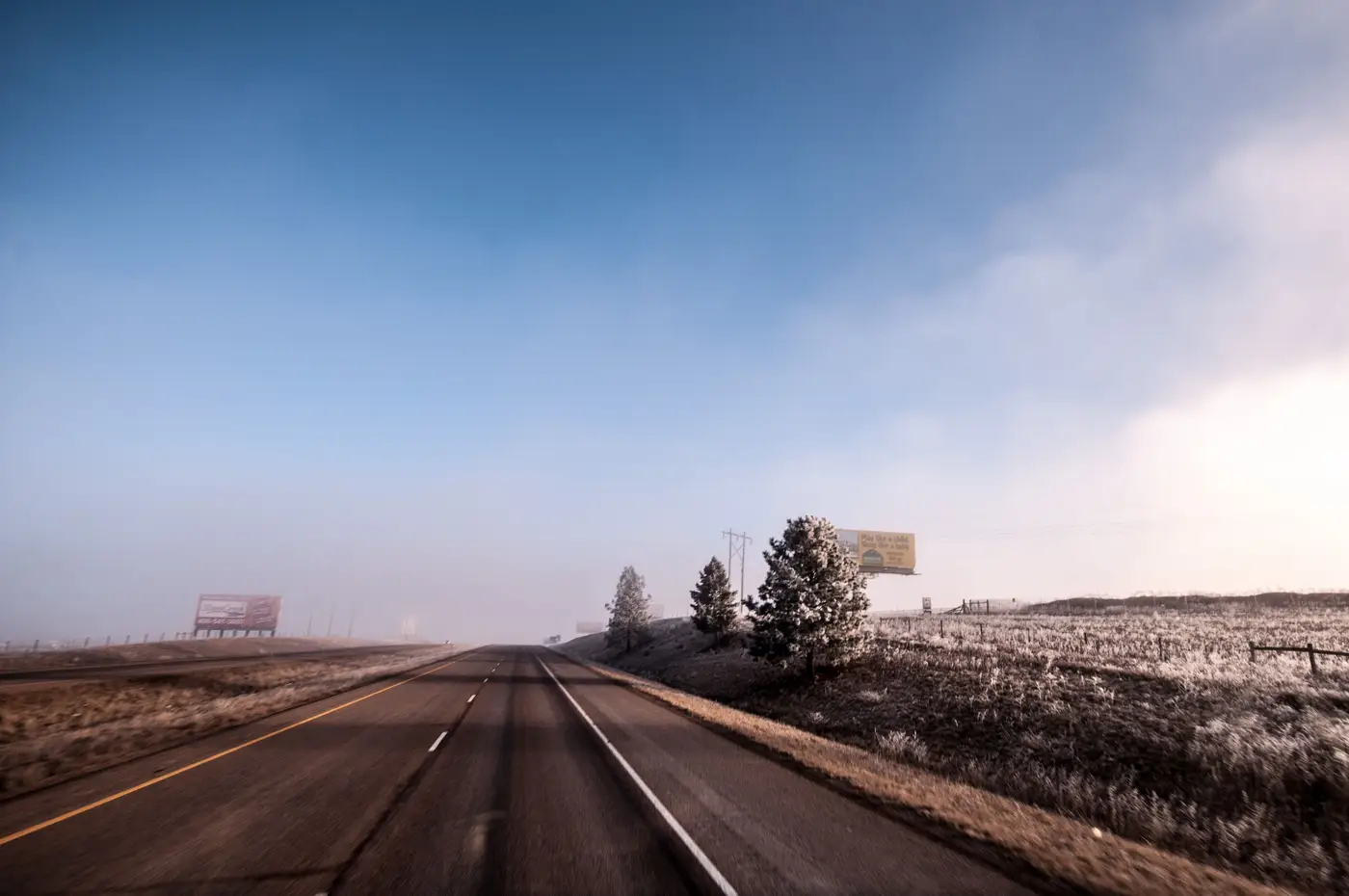
If you've ever had to defend a rate card to a client who's asking "but can people actually read it," you already know legibility distance isn't academic. It's the number that separates a face that earns its CPM from one that's basically wallpaper for people doing 55 past it.
The basic legibility distance formula
The rule of thumb most buyers and sign consultants reach for: about 10 feet of legibility distance per inch of letter height, for simple copy (short words, numbers, a logo). So a bulletin with 3-foot-tall letters gives you roughly 360 feet of legible read distance for a short message. Complex copy, long words, small type, multiple lines, cuts that ratio hard, sometimes down to 3-4 feet per inch, because the driver's eye needs more dwell time to parse it.
This is why a 14x48 bulletin with a four-word headline outperforms the same structure carrying a paragraph. The structure doesn't change. The legibility index does.
Letter height is the easy half of the math. You can pull it from the production spec or measure it off a proof. The harder half is figuring out how much of that theoretical distance the driver gets in practice, which depends on where the face sits relative to the road.
Sightline distance by road speed
Legibility distance is a theoretical ceiling: the farthest a message could be read if nothing stood between the driver and the face. Approach visibility distance is the practical number, how much of that distance the road actually hands the driver once you account for a curve, an overpass, a stand of trees, or a competing structure. Traffic engineers use stopping sight distance as a rough proxy here: at 30 mph a driver needs on the order of 200 feet to process and react to something new in their field of view; at 45 mph that's closer to 360 feet; at 65 mph you're pushing 650 feet. Those numbers come from reaction time and braking physics, not advertising, but they're the baseline most planners borrow when they ask whether a driver has enough approach to read the copy before they're past it.
Run the two side by side and you get your real legibility index for a given face: legibility distance (from letter height) against approach visibility distance (from road geometry and obstructions) at the posted speed. If the road only gives a driver 300 feet of clear sightline but the copy needs 360 feet to read, you've got a face that's technically legal and practically unread for a chunk of the message.
Where the desk math stops being enough
Here's the part that doesn't show up in a spreadsheet: approach visibility changes face by face, season by season, and nobody's measurements agree because somebody eyeballed it from the shoulder three years ago. A face that had a clean approach when it went up might now be sitting behind a utility pole that got relocated, or trees that filled in over two growing seasons, or a new on-ramp that shifts the angle drivers see it from. The only way to really check is to drive every face in your book and look, which is the windshield survey nobody has budget to run on the whole inventory every year.
That's the gap Billboard Mapping is built around: a VHR imagery layer that flags each detected face's location, orientation, and rough approach visibility for a region, so you can sanity-check which structures in your own book (or a competitor's) have an obstructed or awkward approach without putting a truck on every route. It won't hand you a legibility index, that still needs the letter-height math and a local speed limit, but it tells you which faces are worth driving out to confirm and which ones clearly aren't going anywhere near a clean sightline.
If you're trying to prioritize a windshield survey instead of running one blind, that's the problem Billboard Mapping's early access is built to shrink. Join the waitlist to see what an annual inventory layer for your region looks like before anyone else gets it.