V-type vs back-to-back billboards: telling structures apart from overhead imagery
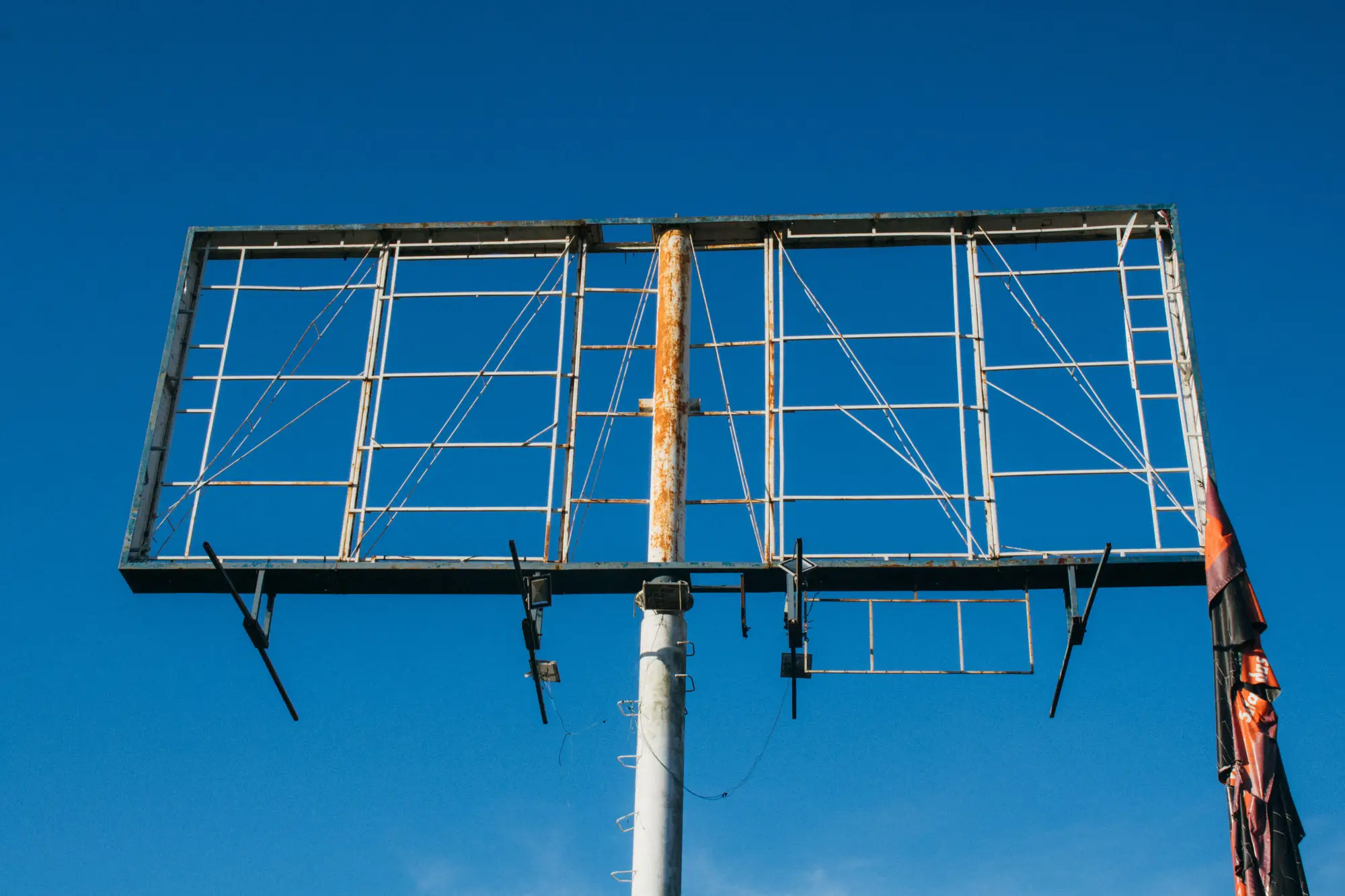
If you've ever tried to reconcile a lease schedule against a set of overhead images, you've run into this problem: two faces on one pole can look like two separate structures, or like one, depending on the angle of the sun and the angle of the imagery pass. Getting the structure type wrong doesn't just mess up a count. It changes how you read approach visibility, because a V-type and a back-to-back serve the same traffic flow in completely different ways.
Here's what each one looks like from above, and the tells that separate them.
Monopole, V-type and back-to-back: what the footprint tells you
A standard monopole with a single face reads as one rectangular panel, one shadow, one support line running back to a single base point. Nothing ambiguous there.
A back-to-back structure puts two faces on the same pole, mounted flush against each other so each one faces the opposite direction of travel. From overhead, this usually shows up as a single panel outline with a thicker shadow edge than a monopole throws, because you're seeing the depth of two sign faces stacked rather than one thin panel. The two faces sit in the same plane, roughly 180 degrees apart, so the structure's long axis lines up with the road it serves.
A V-type splits the two faces apart at an angle instead of butting them flush. Picture two bulletins opened like a book, both aimed back toward the same stretch of road so drivers approaching from either direction catch one face each. In imagery, this is the one that actually looks like a V or a shallow wedge: you'll see two distinct panel outlines meeting at a point or a short shared edge, with a visible gap or angle between them rather than one continuous line. If you can trace two separate rectangles with an angle between their long edges, you're looking at a V-type, not a back-to-back.
The practical test: measure the angle. Back-to-back faces sit at or close to 180 degrees to each other. V-type faces are opened up, often somewhere in the 90-150 degree range depending on the site, because the whole point of the V is to catch both approach directions without either face going edge-on to its own lane.
Shadow and orientation cues that give it away
Shadows are your friend here, not your enemy, as long as you know what the sun angle was doing at capture time. A back-to-back structure casts one shadow mass that reads as a single thick line. A V-type throws two separate shadow shapes that meet at a hinge point, and depending on sun position, one panel's shadow can fall partly across the other, which gives you a useful confirmation rather than noise.
Orientation relative to the road matters too. A back-to-back bulletin's faces run parallel to the roadway it serves, since both faces need to be roughly perpendicular to oncoming sightlines on the same corridor. A V-type's two faces are each angled off that parallel line in opposite directions, which is exactly why they look like a V instead of a bar when you're looking straight down.
One thing that trips people up: a tightly-spaced pair of back-to-back structures at a highway split can look like a V-type if you're only glancing at the overall site footprint instead of tracing each panel's edges. When the two structures have independent pole bases some distance apart, you're looking at two separate monopoles, not one V-type or one back-to-back, even if the faces end up angled toward each other. Pole base count is the tiebreaker when the panel geometry alone leaves you guessing.
None of this replaces a field check when a lease or a competitor read is in dispute, but it narrows down which sites are worth sending someone to look at, instead of running a full windshield survey across a whole market just to confirm structure counts you could have sorted out from the imagery first.
That's the gap Billboard Mapping is built to close: detected faces with location, orientation and rough approach visibility pulled from VHR imagery, so you can sanity-check your inventory or scope a competitor's structures before anyone gets in a truck. If you want early access to that layer for your region, the waitlist is open now.